Divergent by Veronica Roth (unabridged audiobook read by Emma Galvin; 11 hrs 11 min on MP3): This is not a good book to read while on a YA dystopia kick unless you simply cannot get enough of it. The influence on Roth by giants like Collins and Westerfeld is too painfully evident. Our heroine is Beatrice, native of the Abnegation Faction which values selflessness and comes across a bit like an extreme form of Amish. Each Faction is built around a separate value: Candor (honesty), Dauntless (bravery), Amity (peace), and Erudite (knowledge). At the magic age of 16 (what is it about that age in young adult fiction?), you choose the Faction you will spend the rest of your life in – that is, if you pass the initiation. Feeling like she’s not nearly selfless enough to live in Abnegation, Beatrice chooses Dauntless at the last second, and is launched into a crazy world of thrill-seeking and combat. There was plenty of action, and it was kind of fun watching Beatrice grow from a timid Abnegation to a self-assured Dauntless in little jumps. That was enjoyable and believable. The rest of it, while perfectly fine as far as it went, felt like something I’d heard before. It’s certainly not a bad novel. Perhaps I would have enjoyed it more had I not recently read so many other YA dystopia novels. As it is, it was nothing more than a pleasant diversion while recovering from surgery.
It’s interesting how many YA dystopia novels focus on societies where your life path is chosen from a limited number of possibilities and can never change. My guess is that this is in response to the typical teenage angst regarding all the choices they find themselves facing: colleges, careers, relationships. Sometimes it feels like it might be nice to have it all decided for you. Of course, these stories always involve someone who breaks the mold, thus showing the importance of being free to make your own choices. I also think it’s interesting that it’s mostly women (though The Giver by Lois Lowry is a notable exception). Despite the occasional repetition of theme, I still find myself drawn to dystopia stories, YA and otherwise.
A note on the audio: Galvin was fine. Not very memorable, but the characters’ voices were distinct without being caricatures, which is really all I can ask for in a narrator. I’d like to thank Bewitched Bookworms for this book: I won it in one of their monthly Whisper Stories in My Ear contests. Thanks so much!

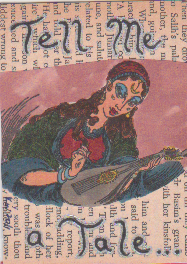


 that was falling apart and shedding pages, so I decided to repurpose it. These are made from those pages, though I colored the illustrations with Copic markers.
 by Lenore Hart: This took me an incredibly long time to read – not because it was hard to get into, but because it lived in my gym bag for reading on the stationary bike. Then I stopped going to the gym because I was too busy with the
  by Isaac Asimov (unabridged audiobook read by William Dufris; 7 hrs 40 min on 6 discs): This time around, Lije Baley is sent to solve a murder case on another planet. I just want to note that sometimes dated SF can be really amusing. In this case, I was entertained by the notion that the “expressway” between DC and NYC takes ten hours. But that’s neither here nor there. As an Earthman, Baley is used to crowded underground cities and always being surrounded by people, be it in the cafeterias for meals or in the public restrooms. The planet Solaria is the opposite: the planet is home to only 20,000 people, each of whom has a private estate and lives more or less as what we would consider a recluse. While three-dimensional holographic “viewing” is a perfectly acceptable means of being social, being in the physical presence of another human being has become thought of as utterly distasteful. Most of the story deals with the society itself, coupled with Baley’s struggles with agoraphobia. I was fascinated by all the different characters, even if the murder mystery felt somewhat artificial. After all, I was more interested in the science fiction part of the story, and in that respect Asimov never lets me down.
 by Russ Colchamiro: Most of this novel is actually two more or less unrelated stories told side by side. The first is the tale of 20-something Jason’s adventures backpacking across Europe for the first time. Much of this plot is rushed and at times appears to be anecdotes from the author’s own experiences quoted verbatim and out of context. The other is about a jar of Cosmic Building Material lost during the construction of the Milky Way. It’s found by chance by a New Zealander, and the rest of the book is spent with various Eternitarians attempting to get their hands on the jar, which is their ticket out of their exile on Earth and back into their posh digs in Eternity. This would have been funny had it been a trifle easier to follow: I kept mixing up characters or forgetting who they were, and the fact that events jumped around in time made it all the more confusing. For the next reader, so you’re not quite so lost as I was: at some point in time, Emma and Lex are beautiful and successful Eternitarians. Some time later they are on Earth, where Emma is hugely fat and Lex is a dog. It took me far too long to figure out that the story alternated between two timelines. Sure, I got that one took place at the beginning of the Milky Way while the other was in 2005, but the character crossovers really sent my head spinning. On the bright side, everything ties up neatly and happily at the end.
 by Isaac Asimov (unabridged audiobook read by William Dufris; 7 hrs 48 min on 6 discs): Lije Baley is a regular plainclothesman in far-future New York City sent to investigate a murder of a Spacer (that is, a person born on one of the many colonized planets). His partner is R. Daneel Olivaw, a disconcertingly human-like robot. Baley is a product of his environment, and like many of his displaced fellow humans he distrusts and dislikes robots in general. Though the social differences between Earthmen, Spacers, and the reader’s own society are the main draw of the book, the story itself is very much a 1950s-style detective story. If you like hard SF, you probably already know to read Asimov, but if you’d like your futurism with some mystery mixed in, this is a good place to start.
 by Suzanne Collins (unabridged audiobook read by Carolyn McCormick; 11 hrs 37 min on 10 discs): Katniss is back home in District 12, richer than ever but still not safe from the Capitol’s reach. I enjoyed the story, even if it was clearly just a bridge between the first and third books in the trilogy. The love triangle was completely forced, reminding me eerily (and embarrassingly) of something I wrote when I was about 14. I like both guys and can understand Katniss’s dilemma, but it was still pretty unbelievable. All the same, it was fun to dive back into this weird world of specialized Districts, and I look forward to reading the third installment that has garnered such strong reactions.
 by Scott Westerfeld (unabridged audiobook read by Corine Montbertrand; 12.5 hrs on 11 discs): Tally is an Ugly, eagerly awaiting her 16th birthday so she can undergo “the operation” to become Pretty, which transforms her to have all the most evolutionarily desirable physical traits. Then she will move to in New Pretty Town and reunite with all her formerly Ugly friends. Until she meets Shay, who speaks of a place where no one becomes Pretty, where everyone is free to look however they look. When Shay disappears, Tally must find her or risk her worst nightmare: Ugly For Life. Obviously there’s more to this whole Pretty deal than it seems at first; of course there’s something to be said for accepting yourself as you are, but if the only change was cosmetic this wouldn’t be a dystopia story. The “hover” technology was a lot of fun from a SF point of view, but the romance was pretty unbelievable: they go from absolutely nothing to twu wuv in no time at all. It felt pretty forced; I guess you can’t have YA without some kind of relationship. Still, I really enjoyed this one. The ending was reasonably satisfying while being very clearly the start of a larger story. I’m curious to see what ends up happening to Tally and her friends.