The Creative Writer’s Survival Guide: Advice from an Unrepentant Novelist
Also posted on BookCrossing.
Read as part of the Books Won Reading Challenge.
The Creative Writer’s Survival Guide: Advice from an Unrepentant Novelist
Also posted on BookCrossing.
Read as part of the Books Won Reading Challenge.

The Early Bird Rate for the 2011 BookCrossing Convention registration expires as the clock ticks over into the new year! That’s just under two weeks away. We are on Eastern Standard Time here in D.C. and so that is when the change will become effective.
If you would like to qualify for the lower $150 rate you must do 2 things:
There are some special deals available now on the website: http://tinyurl.com/bcindcdeals. In order to qualify you must submit your PayPal payment or postmark your check within 3 business days of submitting your registration form. Don’t get disqualified from some great deals by procrastinating on sending in the payment.
(Please note: if you submitted your forms prior to December 1 and you have already paid, you will be grandfathered in and are qualified for promotions regardless of the length of time it took you to pay).
What are you waiting for? We want to see YOU at the convention in April, so register today! http://tinyurl.com/bcindcregistration
Perfume

Now I’m terribly curious to see how they managed to make a movie out of a novel built around smells.
Also posted on BookCrossing.
Paper Towns
Beowulf & Grendel
Each winter, I spend hours composing the letter to be included with the Christmas cards I send out. I write with my audience in mind – mostly relatives and far-away friends. This year I included things like the Japan and Amsterdam trips, Snowmageddon, the troubles with our HOA, and the various conventions and other events we attended. I include some photos of the two of us and, occasionally, a URL at the bottom (usually for an online photo album). I try to keep it interesting and upbeat. Every year I receive compliments from a few of the recipients, saying how much they enjoyed reading about my life.
Ah, but every year there are also those people who declare their hatred for the Christmas card letter. Not anyone I send to, as far as I know, but around the blogosphere I always come across people who think of those letters as bland, impersonal, and worst of all, nothing but a bunch of bragging.
Maybe my experience is atypical, but I’ve never gotten this impression from any of the Christmas card letters I’ve received. But then, I also might be a different sort of audience. I want to know where you vacationed or how your kid’s soccer team did this year, because I care about what happens in your life. If I didn’t, I wouldn’t be exchanging Christmas cards with you. And even if I keep up with you during the year, I really enjoy the big recap, seeing which events you found most worth sharing. I don’t expect you to write it all down by hand just for me.
I admit, I am suspicious of those people who get disgusted by positive Christmas card letters. Do you not want to celebrate your friends’ and family’s triumphs with them? No, no one’s life is 100% perfect, but to me, the end of each year calls for reflecting on what you’re grateful for from the past twelve months. Why would I want to gripe about gaining twenty pounds when I could share my excitement about the new running program I just started?
For me it just comes down to practicality. In the letter, which I type mostly because my handwriting is atrocious, I cover the things I want to tell everybody. In the card, I often don’t have anything more to say than that. I’ve chosen the card based on the sentiment printed inside, so writing an additional “Merry Christmas” or “Happy Holidays” is kind of pointless. The recipient list is written from scratch every year, and though many of the names are the same from the previous year, there are always a few changes. In short, though people receive a store-bought card and a printed letter, there’s a lot of thought put into the whole process. If I didn’t include the letter, I wouldn’t see much point in sending cards at all. My handwritten notes would have to be composed ahead of time anyway or else each card would be full of scratch-outs. I do my best brainstorming at a keyboard, so if it’s going to be typed anyway I might as well just print it out instead of rewriting it. And I’ll want to tell each person about pretty much the same things, since after all I lived the same year no matter whom I’m writing to. And by that point I might as well just send the same letter to everybody.
So yes, I am a little hurt that there are people who believe that just because something was printed with a computer that there was somehow less effort put into it, or less thought given to the people receiving it. I write my letter because I want to share my life, not because I want to show it off. And I look forward to the letters I get from others, so I can share their lives too. To me, that sort of sharing and connection is the point of sending out all those cards in the first place.
How do you feel about holiday card letters? What do you feel is the purpose of exchanging cards every year?
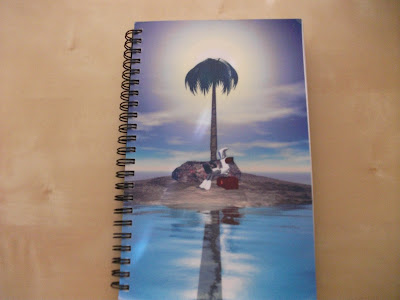
In March of this year, my husband and I went on vacation in Japan. I brought a special journal just for the trip, made special from CafePress with art from the first issue of BS/OD on the front. I’m not a huge fan of CP, but this was the only place I could find with decently-priced, customizable, unlined, spiral journals. (But it could be that I’m just too picky.)
Note: I have since discovered the joys of Vistaprint, which often runs free+shipping deals on their custom journals.
Partly it was because I’d never taken a trip like this before and I thought it might be nice to try out travel journaling. Partly it was because I’d heard that many JR and Tokyo Metro stations have unique rubber stamps (like these). Since my regular diary is lined (by necessity – my handwriting is out of control), I decided to get something special just to drag around Japan to record the many experiences we were bound to have.

Train stamps from Osaka
It turns out it came in handy when putting together both my own recap but also my husband’s own blog posts. It’s amazing the amount of stuff you forget unless you write it down that moment.
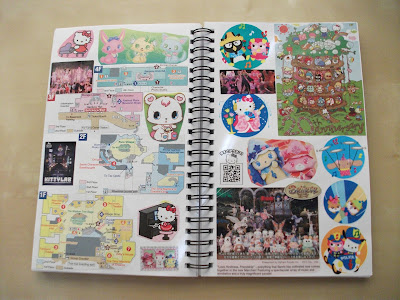
One of the Sanrio Puroland spreads
But of course a week’s worth of vacation isn’t enough to fill an entire journal, so I glued in a print-out of my recap, then used the rest as a gluebook for the various flyers, brochures, ticket stubs, and other paper matter I collected during the trip. It took a long time. I started by separating everything into categories: Akihabara, Parasite Museum, Sanrio Puroland, capsule machines, Osaka Castle, Osaka Aquarium Kaiyukan, capsule hotel, Ghibli Museum, transportation, food, and miscellaneous. I went through and cut out all the pictures/words I wanted to include in my pages, then arranged them on the page, then glued them down. I did it one page at a time, keeping the categories together and generally working in chronological order. Whenever I finished a category I would take any leftover clippings and put them in their own container. (Clear plastic sheet protectors work remarkably well for this.) At the end, I did a few miscellaneous pages using the leftovers. I still have quite a few pages left, but I think I’ll leave it alone for now. I’m just so pleased to have finished this somewhat major project – and it only took three months! :)
For more on our trip to Japan, check out my husband’s series of videos: people, Sanrio Puroland, animals, and trains.

Finished!
I was looking through some stuff the other day and was reminded of a comment one of my reviews had received, suggesting that instead of just calling something a children’s book, I should name a specific age range. It occurs to me that I have absolutely no idea how to define such things. I believe I have two major factors working against me:
I am also at a loss to define “age-appropriate” in terms of subject material. I could probably rate books in terms of vocabulary, but who am I to say what topics are or are not suitable for a child of a certain age? Most banned/challenged books become that way because someone believes it is inappropriate for children of a certain age group. When do people magically become old enough to handle any variety of topics? I say if you’re in high school, you should be capable of handling adult themes. I read Night
So, how do you determine the proper age range for a book?
At some point I became a book reviewer. I’m not sure when this happened, exactly, but I now receive review requests every month. Which is fine, of course: as a book lover I certainly am not going to complain about people giving me books. And lately authors have been really good about offering me books I actually might want to read. I have, however, fallen behind on my reading. I warn anyone asking for a review that it could be several months before I even crack open their book, and so far that’s dissuaded no one. I take this as a good sign, especially since my reading habit has dwindled as of late. It’s not that I don’t enjoy what I’m reading, just that I often find myself doing kakuro puzzles instead.
While I’m here, I’d like to share some random tidbits about my reading/reviewing life:
Maybe over the holidays my reading will pick up speed again. I think the first step is tossing that kakuro book.
One of my favorite art journaling blogs, Daisy Yellow, had a post this morning about how goals are irrelevant if unpursued. It’s a very simple statement, but very true, and something I don’t think about nearly often enough. For each goal, you should either let it go or get serious about it. She talked about looking back over her goals for 2010 and saying that while she did a lot of things this year, they weren’t things on the list, and they need to be things on the list. Or else the list needs rethinking.
After reading this, I looked at my goals for 2010, most of which aren’t particularly important to me. Then I looked at my bucket list, and realized that I’m not making the least bit of effort toward doing any of those things. Why not? I don’t know, but it’s clear that I need to re-evaluate what I want to accomplish in this life.
What are your goals? Are you actively pursuing them? If not, why not?
© 2010-2026 kate weber All Rights Reserved -- Copyright notice by Blog Copyright