Time of the Twins by Margaret Weis and Tracy Hickman

Time of the Twins (Dragonlance Legends #1) by Margaret Weis and Tracy Hickman: It’s been years since I read the Chronicles trilogy, but I managed not to stay lost for too much of this book. (I do, however, strongly recommend one reads that trilogy before starting this one.) Basically this is Weis and Hickman accepting that Raistlin is the only truly interesting character in Chronicles and throwing in the second-most interesting, Tasslehoff, for good measure. Raistlin is hungry for power, and believes he can get it by traveling back in time to before the Cataclysm. His twin brother, Caramon, is sent after him, along with religious nut cleric Crysania, who finds herself strangely drawn to Raistlin. Tasslehoff joins them, much to the horror of everyone, because kender are nothing but Trouble. All in all, I rather liked this book. I doubt I would have if I didn’t like Raistlin so much, as I spent most of the book wanting to punch Caramon in the face. As has been noted by many, this is unquestionably written for young adults. If you know that going in, you’ll probably enjoy it more. I look forward to reading the rest of the trilogy.

Also posted on BookCrossing.

Intervention Sketching

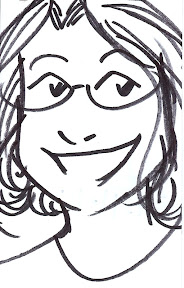
Me, as sketched by Alex Heberling of alexsguide.net. I'm a poor judge of how much it really looks like me in particular, but my cowlick is spot on!

This past weekend I attended Intervention. We were in the Artist Alley, which always means a lot of time behind a table with people occasionally coming up to talk to you (and/or buy stuff). From time to time I’d wander around and chat with folks, but mostly I just sat and amused myself with my sketchbook.
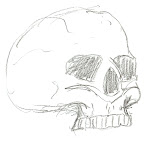
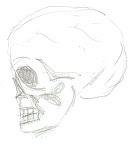
A couple of random skulls

On Friday evening I participated in a special session of Dr. Sketchy’s Anti-Art School. Our model was dressed as Kali, complete with skull necklace and blue skin. Most of my drawings pretty much suck (30-second poses are not my forte), but I got a couple halfway decent ones I inked and colored the next morning.

Not the best, but certainly the most complete drawing I did that evening.

During the breaks they introduced Stupid Artist Tricks contests. The first was of Kali destroying the world, and mine was chosen as one of the top three by the staff, which would then be voted on through applause. I got by far the least applause, but I was so psyched to have been chosen at all that I didn’t mind. Besides, the girl who won totally deserved it. Her Kali-meets-Katamari was brilliant.

My last-place masterpiece.

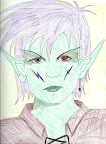
By Sunday morning I was starting to get bored and uninspired, so I colored some old line-art drawings I did at another convention, possibly Otakon 2008.

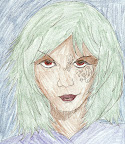
After I ran out of things to color, I drew a vampire chicken.

Look, I don't know.

Anyway, I loved Intervention and we will definitely be there next year. And I’ll probably continue to draw inexplicable things.

The Immortal Ones by John F. Ferrer

The Immortal Ones by John F. Ferrer: Derek lives a life of horror-movie fantasies until he meets a girl at a club and those horror movie monsters turn out to be real. Overnight his life is turned upside-down. Though there is a fair bit of action, the love polygon is the backbone of the story. Werewolves love vampires; vampires love humans; humans love werewolves; it’s all just a mess. There are definitely echoes of Twilight here, but with more sex and less angst. The vampire and werewolf mythos are a little different from the traditional as well. Like in Buffy the Vampire Slayer, vampires look like ordinary (though beautiful) humans until they get angry or hungry, at which point their faces “crack” and the fangs come out. Werewolves are pretty much hairy vampires: they also wolf out under stress, live forever, and drink blood. Both species can learn to keep their respective transformations under control. Both have a preference for human blood but can survive on the less tasty blood of animals. Werewolves, however, like vampire blood best of all, and are arguably the only thing (besides the sun) that can kill a vampire. (Whether or not a werewolf can be killed remains to be seen.) The other twists are more subtle: gold (not silver) hurts werewolves, and vampires (but not werewolves) are weakened by wolfsbane. (To be fair, Dracula was kept out by wolfsbane.)

Like many self-published books, this one is in desperate need of a good editor. The author clearly has a basic misunderstanding of punctuation. For most of the story I felt less like I was reading a story than having one described to me. The main characters were all fairly interchangeable in terms of personality, but I did enjoy a couple of the minor walk-ons, like Hank from the jazz club and Emma from the bookstore. I could easily see and hear them in my mind. So would I recommend this particular book? Well, no, but I do see promise in Ferrer. He has good ideas, and proper execution can be taught. I look forward to seeing what he can do with time, training, and a really good editor.

Also posted on BookCrossing.

More Pet Peeves

Check out the original list. Evidently I’m not done yet. Here are some more tips for writers who want to avoid irritating me their readers:

  • Avoid repetitive statements. He shrugged his shoulders. What else, pray tell, can one shrug?
  • Give your characters distinct names. I don’t mean unusual, necessarily, just noticeably different from each other. Once I had to quit a book after only a few chapters because I couldn’t keep Johnny, Jack, Jackie, Jerry, and Jimmy straight in my head. (No, I’m not making that up.)
  • Be consistent with your names. It’s fine to refer to Jack Smith as either “Jack” or as “Smith”. You can even call him “Smith” in the narration and “Jack” in the dialog from time to time. Just don’t switch back and forth constantly. Pick one and stick with it.
  • Have someone read your book aloud to you, preferably someone who’s never seen it before. Make notes while you listen, but don’t read along. Realize that this monotone is how every reader will “hear” your book in their head.
  • Careful with description. If the clouds around the mountain have nothing to do with moving the story forward, don’t spend three paragraphs on them. Readers don’t want to be stuck in a white room, but we also don’t care about the cuckoo clock’s personal history unless it becomes important later.
  • If you want to write a movie, write a movie. Don’t write a book. I cannot stress this enough.

Any more I’m forgetting?

Booking Through Thursday – Disaster!

You’ve just dropped your favorite, out-of-print book into a bathtub, ruining it completely … What do you do now?

Whine. Post on the BookCrossing forums about it. Then pop onto AbeBooks and see about finding another copy.

One time my cat urinated on my backpack, utterly destroying the book I was currently reading. But then, it was The Da Vinci Code, so she may have just been commenting on my taste in literature.

Foundation by Isaac Asimov

Foundation by Isaac Asimov (unabridged audiobook read by Scott Brick): It is rare that I read a story set so far in the future that Earth is practically a myth. This basically means that you can set up human society to be whatever you wish, without the burdens of the history known by the reader. In this case, the human race has grown into a massive galactic empire. Hari Seldon is a prominent psychohistorian, who uses his studies of the past to predict the future. Specifically, he predicts the collapse of the empire, and claims to be creating a great Encyclopedia Galactica to save all the knowledge of man in order to ease the transition after the fall. Frightened by the idea of civil unrest in response to this foretelling, Seldon and his people are exiled to Terminus, a planet far out on the rim of the galaxy. The rest of the book chronicles the next two centuries or so. Much of it was a little slow, since I’m not much for politics, but I very much enjoyed Mayor Hardin. I have the second book in the trilogy on my shelf, but I’m not sure when I’ll get to it. On the one hand, I’m not in any hurry to return to the universe of Foundation, but on the other, the longer I wait the less I’ll remember about Foundation, which will probably make Foundation and Empire more difficult to follow. Heh.

Also posted on BookCrossing.

Intervention and SPX

Through some sort of scheduling mixup, my much-beloved Small Press Expo and the brand new Intervention are happening the same weekend (that of September 11th), right down the road from each other. This actually isn’t as catastrophic as it seems. I will be working the Binary Souls / Other Dimensions table in the artist alley at Intervention, but I already plan on taking part of Saturday afternoon to go check out SPX. I can’t miss it – it’s quite possibly the most inspiring day of my year. Intervention, however, also looks pretty interesting: it’s dedicated, more or less, to internet pop culture.

So if you’re in the DC metro area next weekend, head on up to Rockville, Maryland, and say hello. I’ll even draw something for you if you ask nicely.
Creative Experiments at Daisy Yellow

Daisy Yellow is an excellent blog about art and creativity, especially in terms of your daily life. I’m a fairly new follower but I have found it an invaluable resource for inspiration.

Every month she posts new creative experiments meant to challenge you in new ways. I’ve decided to participate in these for September. I will not be doing all of the challenges, but I think I can commit to these:

♥ Carry a notebook with you for a month, adding notes, scribblings, to-do’s, sketches, doodles, coffee stains and whatever you wish. — This isn’t too different from what I normally do, but I’ll try to be more mindful of actually taking the notebook with me when I go out.

♥ One day this month, write a thoughtful description of 5 sounds that you encounter. — I am fascinated by this idea.

♥ Create an itunes playlist or mix CD with 15 songs that make you feel just right. — This will be the most difficult, as I don’t listen to much music these days.

♥ Read four (4) books this month, fiction or non-fiction. — Not a problem.

I think it’ll be fun. Now to go find a notebook…

Ishmael by Daniel Quinn

Ishmael by Daniel Quinn: I picked this up because a friend highly recommended it, saying it was one of her favorite books of all time. Basically, the narrator comes across a classified ad in the newspaper advertising a teacher in search of a student with an interest in saving the world. The narrator, who was too young to join the hippie movement but was nonetheless enchanted by their ideals, looks up this teacher out of curiosity. From then on the book is almost entirely their sessions together, learning about the mythology of the “Taker” and “Leaver” cultures, respectively, and how to “save the world”. I alternated between interest in the story and exasperation at the preaching. The ending was too predictable and too convenient, but I’m not sure how else it could have ended. As for the philosophy, well, it certainly wasn’t a life-changing experience for me. I was left with too many questions. Living in harmony with the planet is certainly a worthy endeavor, but never are issues addressed like, for example, travel. Transportation requires a disruption of the natural order: trees and animal habitats must be swept away to lay roads, runways, and rails. Sure, it’s easier to adapt to your surroundings if you never go anywhere, but such isolation also sows xenophobia and superstition. This is not to say we shouldn’t strive to coexist peacefully with the rest of nature, or that it is our right and duty to reshape the world to suit our purposes. Not at all. I just felt that the arguments presented here were incomplete. They also propose that we who have plenty should not aid those suffering from famine and drought. I understand the idea behind it – it will just lead to overpopulation and more famine in the future – but I am not comfortable with the lack of compassion.

All that said, I must give this book high marks for giving me quite a lot to think about. Its insufficient arguments and somewhat ham-fisted narrative style aside, it made me ponder things I’d never even considered in the past. It instilled in me a desire to research the ideas presented in order to form my own opinions on subjects I never knew were up for debate. I certainly recommend it to anyone in search of a thought-provoking read.

Also posted on BookCrossing.

Unplug Day – 31 Aug 2010

To celebrate the release of Lane Smith’s new book, It’s a Book, Macmillan Publishers are celebrating the first annual Unplug Day tomorrow. The tag line is, “unplug. unwind. recharge. read a book!”

I prefer to read print books and do not own an ebook reader, but I still won’t be participating in this. It’s on a Tuesday. I can’t go computer-free on a workday. (But I may spend the evening reading. That could be nice…)

Click for larger version

Hat tip to Book Patrol.

© 2010-2026 kate weber All Rights Reserved -- Copyright notice by Blog Copyright