Tag Archives: art

Rapid Sketching

My husband specifically requested I scan and post more of my sketches, and I’m diving straight into the deep end with these.

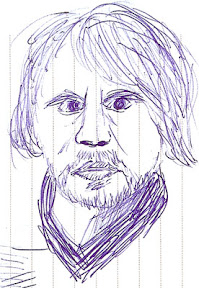
Sometimes, for practice, I’ll grab a random pen and sketch quickly in some random notebook. No fancy pencils or sketchpads, just plain old ink and paper. I usually work from photographs, since they’re convenient and I feel more comfortable with them than drawing from life. (I know I just committed a major sin in the art world. Forgive me; I’m a novice.  If I don’t have a photo I usually end up just doodling aimlessly.) A few weeks ago I was at a coffee shop with a friend while she studied for her Physics exam. I was ostensibly there to answer questions, but she ended up not needing me (and later thanked me for providing my Aura of Science). So I decided to pull out a ballpoint pen and draw. What I drew was not what one would call polished or even particularly attractive, but it was fun.

weird cat logo

Simply terrifying.

Lesson learned: closer objects, like eyes, should be larger than those farther away

She's a man, baby!

This one sent my friend into paroxysms of laughter

Needless to say, these aren’t finished products.  I’ve never been very good about the whole “sketch something a few times before drawing it for real” practice either, so nothing like these will probably ever be seen ever again.  But you know, I’m actually kind of proud of them, since I was just using a crappy pen picked up for free at a convention and a $3 Target notebook.  I’ve been rather taken with Michael Nobbs’s inspirational (and free) e-book, and it’s made me think that maybe I should try to “draw my life” – or at least try combining quick sketching with life drawing – more often.

Introducing the Pink Camo Book

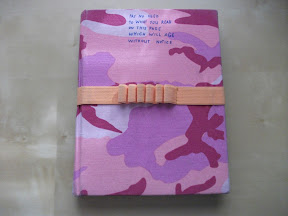
I’ve mentioned the “pink camo book” on a number of occasions, and most of the time I think people assume it’s just some random name based on a brand or something. Actually, it’s far less interesting than that: the design – on both the cover and interior pages – is pink camouflage:

I wrote the bad poem in middle school. Shut up.

Pink camo on the inside too

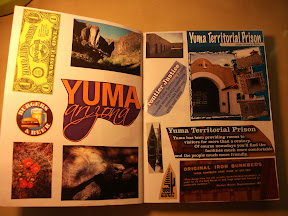
I originally purchased the thing at a Target in Yuma, Arizona, in early 2008. It was the only unlined notebook in the place, as far as I could find, and I’d decided that I wanted to do some art journaling during my 24-day sojourn in the Grand Canyon State. I didn’t end up doing very much drawing, just some doodles during the long overnight tests (I was there for work). I glued in assorted clippings from the places I visited, but otherwise didn’t do much with it – in fact, that trip only filled 9 pages, front and back.

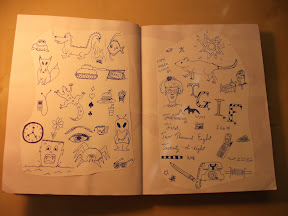
Forgot my book one night, so I pasted in the doodles

Yuma paraphernalia

Since the pink camo book was both cheap and ugly, I felt no compunction about turning it into an “anything” book: I drew it in while bored in the Artists Alley at AUSA or MAGFest; I used it during my brief time with dailydrawing; I used it for character designs for my unfinished graphic novel; I pasted in clippings from brochures whenever I visited somewhere, even just downtown DC. Many of my more recent pages have been of places visited while on snarfari. I now pack it for most trips and enjoy looking through it from time to time.

Philadelphia paraphernalia

Me drawing at AUSA 2009

The concept of trash pages is essential to any art. If you don’t want to put down anything that’s not pristine, you’ll never get started. Everybody needs somewhere to practice. This is why I carry around beat-up old notebooks for writing, and why I have sketchbooks like the pink camo book. I am wary of gorgeous leather-bound journals – I don’t want to mess it up with my crappy doodling and stream-of-consciousness babbling, so it just stays blank forever. That’s not useful. Now if I can just convince myself that all my sketchbooks are actually just sketchbooks and not pre-bound portfolios, I’ll be in business.

Trash pages.

What sort of “trash pages” do you use? Are they barely-started tunes in a folder on your computer? Stitches tried out with remainders? Or are you confident enough to use Moleskine notebooks or expensive yarn? Do trash pages apply to all creative pursuits?

Cutting and Pasting

For whatever reason, I really enjoy cutting up pieces of paper and gluing them to other pieces of paper. This is the essence of gluebooking. It’s a little bit collage and a little bit art journaling and a lot instant gratification.

Before we go on, I will openly admit that I don’t really understand the difference between art journaling, gluebooking, and scrapbooking. While my husband likes to tease me about my scrapbooking habit, I maintain that as long as I’m not using photographs and word balloons, I’m not technically a scrapbooker. But that’s just semantics. In all of them, you are more or less creatively preserving memories.

I’ve never gotten the hang of keeping a sketch journal. I’m notoriously bad about keeping up with any kind of “daily life” photography, which is probably a related failing. Despite spending so much time drawing, I don’t really think in pictures: I think in words. I’ve kept a regular paper diary since November 1991, yet it is extremely rare that I draw or paste anything in those diaries. I don’t know why, exactly, since those are the things I am most likely to want to look at when I go back through them.

As with many things from my childhood, I first started clipping pictures out of magazines because my older sister did it and I wanted to be just like her. She would re-cover folders, notebooks, and binders with her finds. I pasted stuff into old school notebooks, usually with a big X of Scotch tape across it. I’m not sure when it occured to me just how much tape I was wasting by doing that.

These days I use gluesticks because they are relatively non-messy and don’t yellow with age the way many tapes do. They are perhaps not the most durable of adhesives, but they serve my purposes. (And you can buy them in bulk.) I also don’t go out of my way to find things to cut up anymore, the exception being if I need something for a specific project (like the sketchbook project I’m doing now). Plenty of paper matter ends up in my house, not just from unwanted magazine subscriptions and generous swappers who send ephemera, but also from my weird compulsion to pick up brochures, leaflets, and flyers whenever I come across them. I think it’s related to my overwhelming attraction to free stuff.

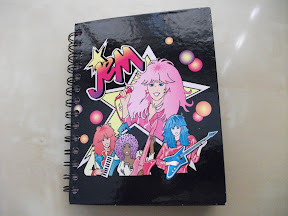
The Jem Book

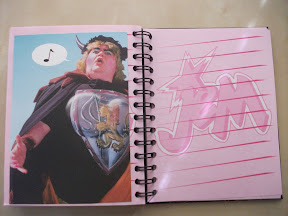
Jem book interior

At the moment I have four books in progress. The first is called the pink camo book, which I will describe at length in a later post. The “Jem book”, a notebook with that iconic cartoon popstar on the cover, is my general, catch-all, “I really should do something with these clippings I’ve collected” gluebook. I received it as a gift because I love both journals and Jem, but with only ten lines per page it didn’t seem very useful as a diary. One of my 101/1001 things is to fill the Jem book. As of this writing I have 33 pages (front and back) left. We’ll see.

Jem book interior

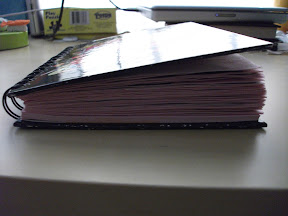
Spiral = good

Two of my other in-progress books are travel journals from my recent trips to Japan and Amsterdam. I designated specific journals just for those trips and they follow the same format: handwritten entries done while I was there, the LiveJournal recap printed out and glued in, and the rest of the pages filled with clippings from brochures from the various places I went. I have absolutely no idea when I will finish these. At the moment I have pasted in the LJ entries for both, and in the Japan journal I’ve completed only two places: the Parasite Museum and Sanrio Puroland. But I think they’ll be fun to look through after they’re done.

Amsterdam journal interior

Japan journal - Sanrio Puroland pages

Do you gluebook? Does it sound crazy? Pointless? Or just like scrapbooking?

The Swan Thieves by Elizabeth Kostova

The Swan Thieves by Elizabeth Kostova: Dr. Andrew Marlowe, psychiatrist, tracks down the three major women in the life of painter Robert Oliver to figure out why the man attacked a painting in the National Portrait Gallery. His wife (Kate) and his mistress (Mary) both tell abridged versions of their life stories, which are interesting but not especially relevant. Interspersed are letters from 1879 between a young painter (Beatrice) and her husband’s uncle (Olivier). The ending is long in coming but predictable nonetheless, and somehow unsatisfying as well. That said, I very much enjoyed this book, if only for the passionate descriptions of painting, both the act and the appreciation of. It filled me with a longing to paint, to draw, even just to visit an art gallery. Sure, the story didn’t really go anywhere, but for once that didn’t bother me. Still, I’m not sure who I’d recommend this to – maybe a struggling artist in need of inspiration. It certainly inspired me.

The audio version of this book is decent, with a full cast of narrators. I could have done without the occasional music in the background, and I saw no reason for Beatrice and Olivier to read with such obnoxiously fake French accents, but otherwise it was pretty good.

Also posted on BookCrossing.
Read as part of the Books Won Reading Challenge.

Thing-a-Day

I totally slacked on this and forgot to post this in time for people to actually sign up, and for that I apologize, but I suppose I might as well let y’all know what I’m up to this month: Thing-a-Day. Based on an idea by the incomparable Ze Frank (whose videoblog The Show was simply excellent and I miss it), the challenge is to create something new every day for the entire month of February and post it publicly on the community blog. It doesn’t have to be a big thing – I plan on doing a small drawing each day in a new sketch book I got for free – but it does have to be something and it has to be completed. (At least, I assume it does. You can’t really claim to have created something until it’s finished, right?)

Anyway, I’m participating. This year’s blog format is on posterous, so everything’s going there. I’m uploading them to my gallery as well, because I am just that kind of exhibitionist. The scans aren’t very good but that’s not really the point. The only really irritating part of all this is that I appear to be in a much later (earlier?) timezone than posterous, meaning that my 3am post on February 1st was timestamped the 31st. What do folks in Europe do? Oh well.

If I remember, I might post a month-end wrap-up about the experience, but if this post’s slackitude is any indication, you can expect that it to actually happen sometime around mid-April.

Basic Drawing: Finale

Originally posted 22 August 2009.

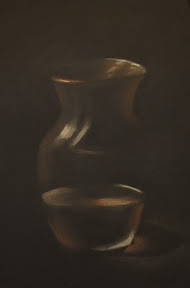
Since our final class was canceled, I opted for showing up this morning during my teacher’s painting class. I was the only one from Basic Drawing to show, so I felt a little out of place, but it was fun all the same. For our grand finale he let me choose my three-piece composition and materials. I went for a bottle, a vase, and a teapot, using chalk pastels on newsprint with an arbitrary color scheme. The colors I chose are such that no sane person would ever purchase in ceramic, but it was fun to use so many hues.

Since it was such a complex scene and my first time doing glass in color, it took me about three hours to complete. But I think I’m happy with it. It’s not my favorite (the lilies still win, and in fact are now framed), but it was a satisfying end to the course. I learned a lot in this class. I’d done a little noodling with pastels but I’d never even given any thought to charcoal or chalk. I had a great teacher and really enjoyed myself. The only thing I would have liked would have been to do more actual pen and pencil sketching. Perhaps next time.

chalk pastel on newsprint

And that’s it. I’ll take another class at some point. In the meantime, I’m thinking about getting some sort of tarp so I can use things like chalk and charcoal and pastels in my study without worrying too much about the white carpet.

Not that I have any clue what to do with my drawings. Most of them aren’t frame-worthy but I can’t bring myself to just toss them. So they’ll probably end up sitting in my closet. That’s okay. It was fun all the same.

Note: this is part of the Basic Drawing Series.

Basic Drawing #8

Originally posted 19 August 2009.

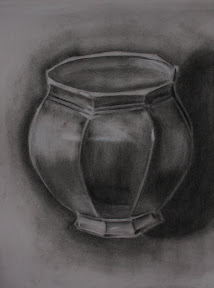
We started the evening with a bugger of a pot in charcoal on newsprint. Just a single pot, not a grouping, but even so it was interesting to compare to our drawings from the beginning of the class. With all the weird angles on this thing, I probably would have been crying had he introduced it weeks ago. I guess I have progressed somewhat.

charcoal on newsprint

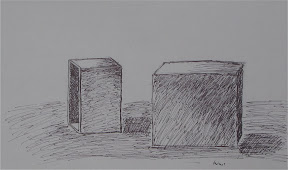
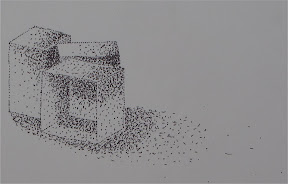
After that we (finally) used our pens a bit. We still haven’t used all those pencils we had to buy (4B, HB, et al), but at least we did have this one last hurrah with our Sharpies. We covered cross-hatching and stippling. The subject matter (boxes) was boring, but the technique was kind of fun. They involve pretty much what they sound like: cross-hatching is shading using overlapping lines, and stippling is shading with varying density of dots (similar to pointillism but in monochrome). My stippling kind of sucks – I was in too much of a hurry, creating more dashes than dots – but it turned out all right in the end.

ink pen on paper

He closed out the evening by giving us some suggestions for drawing experiments, such as sketching animals at the zoo or making clay models and then drawing them. He also assured me that the “old boys” (which is how he refers to various famous painters) drew from photographs, so I should never feel bad about it. :)

ink pen on paper

This was, for all extents and purposes, our last class. Our teacher has a conflict next week: he also teaches at NOVA, and for whatever reason the two overlap by a week this term. He did, however, give us three other options:

  1. Attend the Tuesday morning class. This would be an actual class, but it would mean taking leave from work.
  2. Attend the Saturday morning painting class. The teacher would be there and I wouldn’t have to use any time off, but it wouldn’t be a real class. Also, it would be pretty packed, meaning less personal interaction.
  3. Join him at the Hirshhorn Museum on Sunday afternoon. It’d be fun (and it’s my favorite Smithsonian), but I doubt much drawing would be involved.

I can attend any or all of them. I haven’t decided what I’ll do just yet. In the meantime, I think I’ll go ahead and scan/photograph all my drawings.

Note: this is part of the Basic Drawing Series.

Basic Drawing #7

Originally posted 12 August 2009.

Last night we returned to monochrome to study glass. For our first piece, we started by covering the newsprint with black charcoal, smudging it up a bit with paper towel, and then using eraser and white chalk to draw the three glass vases. It was an interesting exercise, somehow different from starting with black paper. Dirty, too – at the end I had so much charcoal on my face I looked like I was in a production of Oliver! My super-talented Malaysian classmate commented that my one vase looked really transparent. That made me smile.

charcoal on newsprint

Despite the weirdness of the rolly carts and stools, The Torpedo Factory is actually a pleasant place to work. Our classroom overlooks the waterfront, and though the glass is frosted so you can’t see anything, you can hear the buskers all evening. Last night, one of them was playing the theme from The Good, The Bad, and The Ugly on panflute. Entertaining.

chalk on black paper

The second drawing was of a goblet, half full of water, with chalk on black paper. We were learning how much of the outline we could get away with leaving out without losing definition. A lot, as it turned out. The third drawing was similar, though this time it was of a larger vase of water, and we used red Conte crayon for the accents. I was especially pleased with how mine turned out.

chalk and red Conte crayon on black paper

When showing my husband my drawings this morning, I asked him if I could quit my job and play with chalk all day instead. I’m clearly better at it than sifting through the H.264 video compression standard. Alas.

Note: this is part of the Basic Drawing Series.

Basic Drawing #6

Originally posted 5 August 2009.

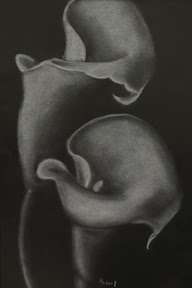
We started with the black paper, using all our white media: chalk, charcoal pencil, chalk pastel, Conte crayon, Prismacolor pencil. The teacher gave us each a Xeroxed copy of a drawing of lilies. I really, really like the way mine turned out. I think it’s the best thing I’ve done by far this whole class.

chalk, white Prismacolor, white chalk pastel, white charcoal, and white Conte crayon on black paper

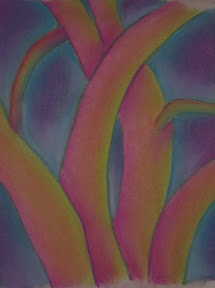
Next we experimented with Fauvism and German Expressionism, which basically meant drawing familiar objects (in this case, tree trunks) using arbitrary color schemes. This was right up my alley, though my trees more resembled a Technicolor sea monster than anything in the botanical world. Most of my classmates colored their trees either red/orange/yellow or blue/purple with a contrasting background. My trees were pink/magenta/yellow/green and red/blue/turquoise with a gray/purple/magenta/turquoise background. My only “color scheme” was to use as many colors as humanly possible. It’s probably a good thing I don’t work in interior design.

chalk pastel on newsprint

I finished my drawings way ahead of the rest of the class, meaning I had a lot of downtime last night. Even my lilies, which I fussed with far longer than I probably should have, were completed when others were barely past the outline stage. I twittered a somewhat disturbing metaphor that popped into my head: “If art were murder, my classmates would all be political assassins. I’d be a hit-and-run.”

Note: this is part of the Basic Drawing Series.

Basic Drawing #5

Originally posted 29 July 2009.

Last night’s class marks the halfway point for this course, and we finally started color. I actually own three sets of pastels, so rather than buying new, I brought them all to see which was the most applicable. This was a fortuitous decision on my part: our teacher specified chalk pastels, but the set I was originally going to bring was oil pastels. So I ended up using my great-grandmother’s set once again.

Our first drawing was of a sunset over mountains. This was strictly a “getting to know you” venture with the pastels, to use a large number of colors and see how they blend. Mine turned out okay, but just okay. After that we completed our “real” task for the night: flowers.
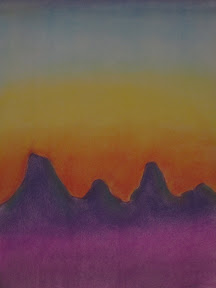
chalk pastels on newsprint

We’d been given an assignment last week to bring in pictures of Georgia O’Keeffe paintings and large-scale images of flowers. I went a little overboard with Google Images and brought somewhere around three dozen pages of print-outs. Turns out to have been a good thing I did: I think I was the only person in the class who remembered to bring in anything. The teacher was unexpectedly grateful when I told him he could keep the pictures. What am I going to do with them? And honestly, I can always just print them out again. Most of my classmates used a picture from the set I brought, so I was doubly pleased to have printed so many.

chalk pastels on newsprint

My sunset was done on my lap, but my flower was on the easel. They both have their benefits and drawbacks. On my lap, the pastel dust more or less stays put without any unintentional smearing, but leaning over the paper is uncomfortable, and I got a lot of pastel on my shirt to boot. The easel was cleaner from a laundry standpoint, but I kept having to blow away the dust as it slid down the paper so I wouldn’t accidentally mix it in the wrong places.

Overall, I think I prefer the easel for large-scale art (we were using the 18″x24″ newsprint pads again). I also discovered an unusual quirk with the easel. See, I am completely right-handed. Indeed, while recovering from carpal tunnel surgery I discovered I am all but helpless with my left hand. But when using a stick medium (chalk, charcoal, pastel, Conte crayon) on an easel, I use whichever hand is most convenient. I didn’t even realize I was doing it at first, but it’s sure (for the lack of a better term) handy.

oil pastels on black paper

The teacher used my drawing to demonstrate stuff to the class, meaning he completed the first two petals on my flower. This head start meant I finished my drawing long before the rest of the class (or maybe I’m just not as fastidious as they and rush my work, which is just as likely). With the extra time, I experimented with the other pastels I’d brought. I scribbled a quick flower with the oil pastels on black paper. It looked kind of nifty but was awfully dark – until the teacher showed me the sorcery of the white oil pastel. See, the white stick turns whatever color is underneath, allowing for better dynamic range for shading, and making the flower look amazing. Magic, I swear. My third set was pastel pencils, which I’d received as a gift. They’re simply chalk pastels in pencil form, presumably used for detail work. I scribbled another quick flower, using as many colors as possible, then blended it all together. It looks kind of interesting, but I think I’ll stick with the white paper for those.
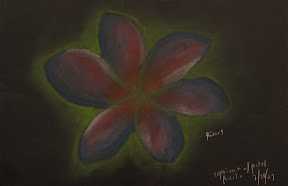
chalk pastels on black paper

I’m very pleased to be using the pastels. The black and white work was getting kind of dry. I do wonder, however, when we’re going to use our pencils. All the pencil work so far has been with plain old #2.

Note: this is part of the Basic Drawing Series.

© 2010-2025 kate weber All Rights Reserved -- Copyright notice by Blog Copyright