Before I met my husband, my entire experience with anime was a vague awareness that Sailor Moon existed. He was a longtime fan, starting with Battle of the Planets when he was a kid. When we first started dating he tried to get me to watch Love Hina, a fairly typical anime romantic comedy. I couldn’t get into it. I didn’t find the insane overreaction to embarrassing mishaps amusing, and that appeared to be the bulk of the humor. I wasn’t interested in Please Teacher either, for the same reasons, and when he tried to get me to watch Trigun I fell asleep.
I usually have no issue with subtitles, but in this case I think that was part of the turn-off. Many of the female Japanese voice actors have high-pitched, whiny voices. And unlike the languages of Europe and the Americas, the cadence of Japanese bears no similarity whatsoever to that of English. For example, questions don’t go up at the end, and the sentence structure is completely different. So I didn’t feel like I was really gaining anything by being a purist.
However, many English dubs are simply dreadful. Homestar Runner’s Stinkoman 20X6 was spot on. You can’t line English words up with an animated mouth speaking Japanese. Well, you can, but it’s just awkward. Luckily, dubbing has improved dramatically over the years, so most of the more recent series are perfectly bearable in English. (Not all of them, of course; Naruto’s “believe it!” just doesn’t translate.) Disney’s handling of Miyazaki’s films is an excellent example of just how good a dub can be.
One of the thing most anime outsiders don’t realize is that anime is not a genre: anime series span all genres, from romance to science fiction to drama to comedy to just plain old weird. It’s a style – and not even a specific style, really. Compare, if you will, characters from One Piece, Tokyo Mew Mew, and Ghost in the Shell:

One Piece
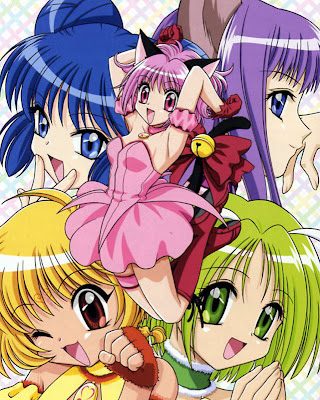
Tokyo Mew Mew
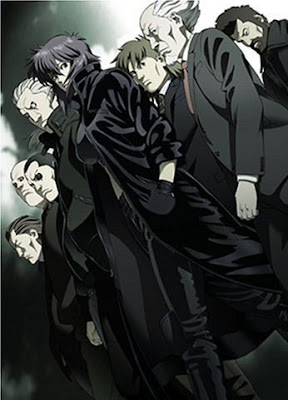
Ghost in the Shell
There’s hardly any comparison, though all three are very common artistic styles in anime. It could also be argued that anime doesn’t necessarily need to be Japanese. I would consider Teen Titans to be American anime, for instance, and there are plenty of anime-style comics from Korea.
Though my husband is quite enamored of this style of art, I’ve come across only a few series here and there that have piqued my interest:
- Outlaw Star: I need to rewatch this one. Basically, it’s a science fiction story about a group of otherwise unrelated characters thrown together to search for the Galactic Leyline, a mythical place said to hold lots of treasure. They have lots of adventures along the way, many pretty hilarious.
- Death Note: My favorite series so far. Bored college student Yagami Light finds a notebook that gives him an immense amount of power: whoever’s name he writes in the notebook will die. He decides to become the personification of justice, killing criminals left and right under the pseudonym “Kira” as uber-detective L attempts to discover his identity. Things get even more interesting when Light teams up with L to “help find Kira.” Throw in additional Death Notes and a jealous death god or two, and you have a fascinating game of cat and mouse. The live-action movies are almost better, actually, because they concentrate solely on the Light vs. L story of the first half of the anime series, rather than introducing later characters such as Near and Mello.
- Kino’s Journey: Kino and her talking motorcycle explore vastly different countries in a strange land, sort of a fantastic interpretation of Gulliver’s Travels meets couch surfing. It’s been a long time since I watched this, so I don’t have much to say about it anymore, except that it was very interesting.
- Naruto: I get a kick out of this series about kids going to ninja school. There’s a whole pile of characters, so you’re bound to find one you like. I’m not sure who I’d count as my favorite, though I’ve always been fond of Kakashi and Gaara. The English dub is decent but often unintentionally amusing, as everything Sasuke says sounds like a double entendre. It’s a long series (220 episodes, plus a continuation in the currently airing Naruto: Shippuden which will almost definitely surpass its predecessor by a large number of episodes) but not one you have to concentrate on, or even necessarily watch all of. After all, a battle sequence can last several episodes without actually moving the plot forward.
- Bobobo-bo Bo-bobobo: Distilled insanity on a cracker, man. It could be argued that a lot of the jokes are Japanese cultural references that fly over my head, but that doesn’t explain a guy whose primary weapon is his nose hair, or the dude made out of gelatin (that everyone wants to eat), or — well, pretty much the entire rest of the series.
Would I call myself an anime fan? Not really. I’ve been to several conventions (usually to peddle wares in the artists alley), but the programming doesn’t really interest me. What about you? How do you feel about anime?
Hat tip to Wikipedia, PSP themes and Marilinunio for the images.
 by Mary Roach (unabridged audiobook read by Bernadette Quigley; 8 hours on 7 CDs): After tackling what happens to the body after death in
 by Dale Carnegie: In general, I do not read self-help books. I find them preachy and uninspiring. This book, however, was highly recommended by a blogger whose post convinced me to give it a shot. I’m glad I did. Though the principles are probably common sense (motivate through praise rather than criticism, listen without interrupting, smile, make the other person feel important, etc.), I believe it did me some good to hear them all laid out in such a straightforward manner. Everybody else on the planet is just as self-absorbed as I am, and they care far more about what they want than what I want. Each chapter began with a principle, described it a little in general, then listed anecdote after anecdote about the principle in action. Most telling to me was the repeated assurance that these techniques only work if the feeling behind them in genuine, not manipulative. People can see through flattery.
 by Stephenie Meyer and Young Kim: I am curious if the Twilight frenzy will continue long enough for there to be a volume 2. But that’s neither here nor there. This is
  by David Anthony and Charles David: Josh and Jozlyn live in your typical Medieval-ish fantasy village, with fairy armies and witches’ holidays. Our story begins on Cauldron Cooker’s Night, a celebration for witches that leaves regular folk cowering under their beds. When the whole town is turned to frogs by a vengeful witch, it is up to Josh and Jozlyn to save them. Along the way they encounter ogres and wizards, magic mushrooms and bog beasts. Master Gramble, the turtle with the brain of a stone, was probably my favorite character, and I hope he shows up in future volumes of the series. The illustrations were fine and detailed. This was more or less a standard sword’n’sorcery tale but I happen to like me some good old fashioned S&S so I’m not complaining. That said, it is undeniably written for children, complete with cautionary asides about not eating wild mushrooms without a parent around and other such things that took me out of the story. Which isn’t a bad thing, of course – it just means that I, as an adult, did not get as much enjoyment out of the story as I probably would have a couple decades ago. However, this would be a fun one to read aloud to your kids, if only to say “griznt” over and over again.
 by David Anthony and Charles David: Three superhero siblings save a small Michigan town from certain peril, this time in the form of aliens peddling hypnosis-inducing ice cream. Their powers are silly (speed and sports; the ability to drive anything with wheels, including airplanes; and anything Superman can do, respectively) but fun. Most memorable for me was the youngest, Zoe, who is still in diapers. I was a little concerned by the idea of a superhero lacking bladder control, but all the same, it was quite clear the authors wrote with their audience firmly in mind. For example, Zoe speaks only one word at a time, all potential vocabulary words; in this book they all started with the letter A but I assume future books in the series go through the alphabet. Adorable illustrations adorn every page. I was amused by the strange little asides and the commentary on sibling rivalry. In short, this is the sort of thing I would probably have enjoyed as a child. I also probably would have colored the illustrations.