Guest post today. Enjoy.
This post was written by Rob Reed. He is the founder of MomentFeed, a location-based marketing, strategy, and technology firm.
Location technologies are transforming how we experience, navigate, and ultimately better our world. From the global to the local, here are #10Ways geolocation is a positive force for good.
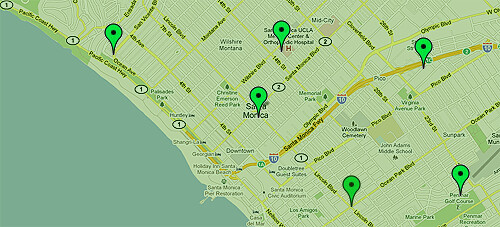
Social media has changed the world. It has revolutionized communications on a global scale, and the transformation continues with every status update, blog post, and video stream. The global citizenry has become a global network.
Since becoming widely adopted just a couple years ago, social media has supercharged social action, cause marketing, and social entrepreneurship. Indeed, the true value hasn’t been the technology itself but how we’ve used it. Today, a second wave of innovation is defining a new era and setting the stage for change over the coming decade.
Mobile technologies will extend the global online network to anyone with a mobile device while enabling countless local networks to form in the real world. We’ve decentralized media production and distribution. We’re doing the same for energy. And we’ll continue this trend for social networking, social action, and commerce.
The combined forces of smartphones, mobile broadband, and location-aware applications will connect us in more meaningful ways to the people, organizations, events, information, and companies that matter most to us—namely, those within a physical proximity of where we live and where we are. Can location-based services (LBS) change the world? Here are #10Ways:
 1. Checking in for Good: If Gowalla and Foursquare have taught us anything, it’s that people respond to simple incentives. By offering badges, mayorships, and other intangible rewards, millions of people are checking in to the places they go. Apps like Whrrl take this a step further and enable like-minded “societies” to form on a local basis. The next step is for these apps to add greater purpose by encouraging more meaningful checkins and offering corresponding badges and stamps, thus mapping the cause universe. Or for a dedicated app to be developed that rewards conscious consumption, social responsibility, and civic engagement. Yes, the CauseWorld app features a cause element, but it’s not about cause-worthy places.
 2. Eating Locally: Sustainability demands that we source our food as close to its point of production as possible. Many so-called locavores subscribe to the 100-mile diet, which requires that one “eat nothing—or almost nothing—but sustenance drawn from within 100 miles of their home.” Given the difficulty of accessing and verifying this information in order to live by this standard, there’s a geo-powered Locavore app. It gives you info on in-season foods, those coming in-season, farmer’s markets, and links to recipes. This rather simple app is clearly just the start. In time, location-aware apps will guide us not only to the grocery store or farmer’s market but through them. All the while identifying foods based on our particular diet or sensibility.
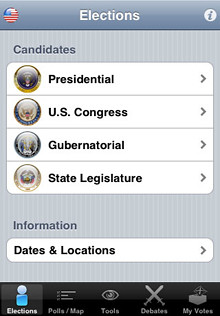 3. Political Organizing: In the next presidential election, politics will not only be local but location-enabled. We saw the power of social media in Obama’s 2008 landslide victory. In 2012, location-based apps and technologies will play a central role in how campaigns are organized, managed, and ultimately won. Much of this will be visible through mobile apps and location-aware browsers. Activists and volunteers will be more empowered. Voters will be more engaged in the moment, right down to casting their votes. Behind the scenes, though, we’ll see massive new sets of data available to campaigns for targeting, empowerment, and optimization. The party, candidate, and/or cause that has the best handle on geolocation will have a measurable advantage. (The Elections app will soon be updated for 2010.)
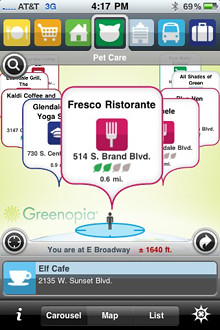 4. Finding Green Businesses: The web has effectively replaced the paper Yellow Pages as a way to find local businesses and services. However, this “stationary web” experience is quickly being supplanted by the mobile web and mobile applications, which give us access to this information when we most need it. The Yelp and Around Me apps are popular ways to find restaurants, coffee shops, or hotels wherever you are, but what about green-rated businesses? Greenopia has transformed its printed, local guides into a dynamic, nationwide mobile application that lets you find local, green-rated businesses in any category. No more paper and a much better experience. The Green Map app is another that facilitates discovery and connects us to local green environments.
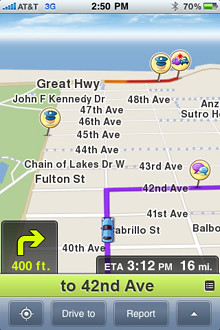 5. Traveling More Efficiently: We’ve had access to GPS navigation systems and static traffic information for some time, but only now are we seeing the full potential of these technologies. With access to more detailed traffic information that is specific to your route and updated in real time, we can minimize congestion and maximize traffic flow (as much as physically possible). The new turn-by-turn MapQuest 4 Mobile app is a good start, as you can get traffic alerts specific to the route you program. However, user-generated information from apps like Trapster and Waze can crowdsource more specific details, such as whether to avoid an intersection due to a toxic chemical spill. Or, if you want to avoid automobiles altogether, Google Maps makes it easy to use public transportation and take a bike.
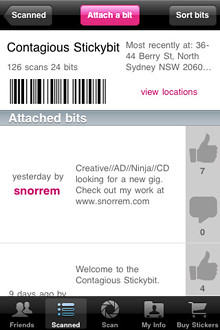 6. Scanning for Ethical Products: With online shopping, we’ve become accustomed to reading reviews and making comparisons before we buy. This can now be done in the physical world through games like MyTown and services like Stikybits. By scanning a product barcode using a smartphone camera, you can unlock a treasure of additional information (not to mention deals) that can help with your purchase. This might include where it was produced, how far it traveled, the reputation of the manufacturer, chemical contents, carbon footprint, or the full lifecycle analysis. Location-aware applications can also transform commerce itself by giving us better access to local inventories and locally-produced goods. Whether it’s fruits and vegetables or books and electronics, if something can be found within blocks of your current location, it makes no sense to ship it from afar.
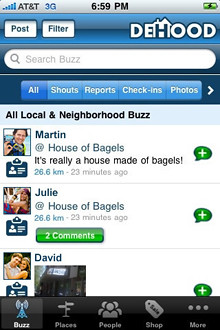 7. Networking Neighborhoods: One of the hottest categories in geolocation is neighborhood networking. The vision for many of these apps is to strengthen the very fabric of our communities. With DeHood, you can keep track of what’s happening in your neighborhood, share your favorite places, and grease the wheels for actually meeting people. After all, if you’ve made contact through the app, it’s a lot easier to say “Hello” in the real world. Blasterous is another that lets you share information locally, whereas BlockChalk does this on an anonymous basis. Finally, NeighborGoods uses your street address to facilitate one-to-one borrowing and trading of useful stuff. In the end, making connections with your neighbors can lead to safer, more productive, and more sustainable communities.
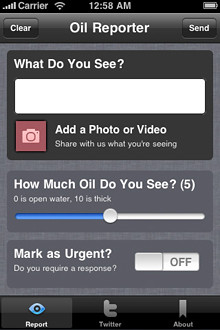 8. Tracking Environmental Disasters: The size and scope of environmental disasters appears to be growing. In 2008, we had the Tennessee coal ash spill, which was billed as “the largest environmental disaster of its kind in the United States.” And that was before we realized it was three times bigger than originally estimated. More recently, the BP oil spill set daily records for “largest environmental disaster in the U.S. ever.” In each case, geolocation technologies can be used by engaged citizens to monitor and track the effects. They can be used by response teams to coordinate containment and cleanup efforts. Ultimately, these technologies can be used to accurately measure the size and impact of a disaster in order to better understand its damages and costs.
 9. Viewing the World Through an Eco Lens: Augmented reality (AR) follows geolocation as one of the hot trends in mobile technology. It enables you to view the world through a smartphone camera (or similar device) and see layers of geo-specific content or information. One of the most popular apps is Layar, an augmented reality browser/platform that lets you choose specific data layers or experiences. The potential for green- and cause-related content is tremendous. You might view green-rated businesses, LEED-certified buildings, or virtual GHG emissions as they enter the atmosphere. Combined with smart meter technology, you could see the most efficient and inefficient homes around you in real time. And for the cynics among us, you could view our mountains, forests, rivers, and oceans as they once were…before the effects of climate change and so many environmental disasters.
 10. Capturing the Moment: Better access to information about what’s happening around us—right now—can dramatically improve quality of life. This sense of “geospatial awareness” is possible through today’s smartphones, whereby a piece of content or information—a moment—is captured and preserved based on the unique time and place in which it occurred. It is essentially to document spacetime. Protests, natural disasters, sporting events, parties, political crises…real-time information about anything happening anywhere at any time, as well as the history of what happened. This will take several years and a number of different applications to realize. In the end, though, it will revolutionize how we access and consume content. It will complete the democratization and decentralization of news and information…based on time and location.
Cautionary note: Privacy is the single biggest issue in the LBS industry. It’s important to understand what information you are sharing with regard to your location and with whom.
Author’s note: We’ll be hosting geolocation events for Social Media Week in Los Angeles this September. This is the third in Max Gladwell‘s #10Ways series of distributed blog posts. It was published simultaneously on as many as 300 blogs.
 by A.M. Lascurain, illustrated by Dariusz and Agnieszka Golen: This is the tale of a jester named Peppy Birthdaycakes and his quest to become funny. He is aided by several other jesters, a dairy maid who also does alchemy, and a turtle with a French accent. In the meantime, the evil (and bumbling) wizard Humidor stalks them. The whole story is laced with puns and other silliness, and on every other page is an absolutely beautiful illustration. Most of my quibbles are technical: typos and grammatical errors are everywhere, and I really wish all of the gorgeous artwork could have been printed right side up. I understand the point of printing them sideways so they fit on the page better, but it’s distracting to constantly be turning the book. On the bright side, they are all rotated to the left, so you only have to turn the book one way. Anyway, despite the technical issues, overall this is a very cute little fairy tale, excellent for reading aloud to children.
 by Scott Westerfeld: In Bixby, Oklahoma, time stops for an hour at midnight every night (though how they know it’s exactly an hour isn’t clear). Only a handful of teenagers experience this “secret hour” and treat it like their personal playground – until Jessica Day shows up and turns the whole thing on its head. Suddenly it’s dangerous, and the “slithers” and “darklings” that used to leave people alone are attacking en masse. Each person has their own special power, and much of the book is spent attempting to discern Jessica’s. I enjoyed this one. It’s the first of a trilogy, but there’s still a decently satisfying end while keeping the way open for more story. I would read the other books were I to find them.
 by Vivian Cook: The subtitle is actually somewhat misleading here, since it’s not actually about why nobody can spell, but rather just a series of anecdotes and quizzes about spelling in general. This is not a book you just sit down and read all at once, but rather something you pick up from time to time and read a few pages. Much of the volume consists of examples of nonstandard (or plain old incorrect) spelling, from lists of band names to photos of business logos. My favorite parts were the ones that dealt with the evolution of language; some of the humor essays on spelling were pretty amusing as well. I suppose if you’re obsessed with proper spelling you might enjoy this one, but honestly I’m not surprised I was able to get it for all of a dollar at Borders. It’s just a bit too niche for me.
 by Geraldine Brooks: The plague strikes in a tiny village, and its inhabitants decide to quarantine themselves in order to prevent spreading the infection. Anna, a mere housemaid to the rector, becomes an unlikely hero through this tragedy. As time wears on and more people die, the villagers become desperate, turning to superstition and even violence. The story covers the entire event, from the delivery of the infected bolt of cloth to the reopening of the village all the way to Anna’s life afterward. When I think of the plague I usually think Middle Ages; this took place in 1666, well after the first colonies in America were founded. Even so, medicine was still quite primitive, consisting of barber-surgeons with their leeches and wise women with their herbs. Perhaps most fascinating is the afterword, where the author reveals that her story was based on the real village of
  by Margaret Peterson Haddix: A teenager named Dorry gets sucked into a religious cult, and eventually leaves. (That’s not a spoiler, given the title of the book.) It was reasonably interesting, but the cult wasn’t very believable. It starts as something akin to Campus Crusade for Christ and then suddenly it’s all fake and dangerous and even criminal. There’s too little build-up, and too little frank discussion of religion. I suppose the author was trying not to offend anyone, but the tip-toeing around certain passages of scripture was a little frustrating. I will say that I liked Angela, even if she was a tad over the top to be truly scary. All in all, it was a decent way to pass the time, but not something I’d necessarily recommend to anybody.
 by Sophie Kinsella: A cute book, but I had a bit of a problem swallowing the premise: a woman on a turbulent plane ride, fearing death, blabs all her secrets to the man next to her. (The man turns out to be the founder of the company where she works, and remembers everything she said.) What kind of nitwit responds to stress by telling a stranger how she finds g-strings uncomfortable? If you can get beyond that, it’s a pretty fun little book. I liked that I didn’t know where it was going, that I didn’t see the Big Drama coming a mile away. I mean, it wasn’t exactly a twist ending or a big mystery or anything, but it was amusing enough to keep me entertained the whole way through. I just wish I’d had a little more sympathy with the main character. I just don’t see the point of lying about your interests in order to impress somebody. If they don’t like you for who you are, what are the odds of having a good relationship with them?