I was browsing back through some old blog entries, looking for new stuff to subscribe to (I did mention I’m a total Google Reader addict now, didn’t I?) and came across this post about the What’s in a Name reading challenge. Funny that I should see this now, considering I’m in the middle of one of them (The Fall of the House of Usher) and have finished reading the rest. Nice.
Children of the Mind by Orson Scott Card
Children of the Mind by Orson Scott Card: This final book in the Ender Quartet spends most of its time tying up loose ends from Xenocide than moving the story along. The fleet still threatens the planet Lusitania, Jane still faces imminent destruction, Miro is still angstful about his love life, and Ender’s still going a bit mad. Everything is tied up neatly at the end, but by and large these latter two novels – Xenocide and Children of the Mind – feel superfluous. I admire Card for his amazing SF ideas, especially the development of the Piggies, but there wasn’t much point in putting all the aiua business in the Ender universe. But that’s okay. Now I know how it ends, and if I care to reread the series in the future, I’ll simply stop after Speaker for the Dead.
Also posted on BookCrossing.
Mr. Peep Goes to Illinois
Howdy, Peep here. Recently my Markeroon melydia and I took a trip to central Illinois. (She calls me her mascot, but I’m the real brains in this outfit.) She was muttering something about visiting her parents or some such, but I know she really wanted to go so she could take pictures of me posing with historical markers. I overheard her telling her parents about a few signs she knew about, and they decided to take a little tour around town.
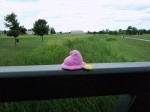
Me by the cattails
We started by Parkland College, where we saw the Champaign County Worker’s Memorial and the Tribute to Olympic Athletes. (One wonders why the apostrophe is so positioned, since they are presumably honoring multiple workers, but hey, whatever. I’m just the talent.) The weather was gorgeous, and mely couldn’t resist taking a photo of me by the bed of cattails creek.
From there we struck out into the unknown. Though melydia only knew of one other marker in particular, her dad was surprisingly enthusiastic and came up with several possible spots to check. The first was the oldest bridge in Champaign
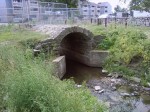
Old Bridge
County, which unfortunately was missing its sign. It also seemed to be undergoing some construction. We found some rope, a computer speaker, and some car keys near by. Dad figured the rope could come in handy and Mom took the keys to return them to their owner (they had grocery store cards attached), but we left the speaker. I could have used it for my secret mascot rave parties, but melydia would hear none of it.
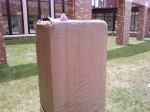
Me on the covered marker
The one other marker melydia knew of in the area was by the county court house, which has evidently been undergoing construction for some time. We found the marker, but it was all covered up. Here’s a photo of me as proof of our visit; melydia’s parents said they would return later, after the construction was finished, to take a picture. We then planned to hit campus, but first Dad suggested we first stop by the Urbana Free Library. The plaque was too small to accommodate me, and melydia’s husband somehow managed to “forget” me when taking a picture of a beautiful new statue called “Slow and Steady”. Hmmph.
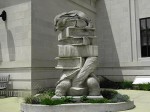
Slow and Steady
Campus was a wealth of markers. We started at the Hallene Gateway, which is basically the doorway of old University Hall, which burned down or something in 1938. Evidently this part of the building was found in some basement somewhere
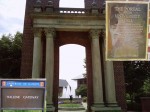
Hallene Gateway
and they decided to make a monument out of it. It was a good thing mely had the good sense to bring her parents, because she never would have thought to visit this gateway. Or the Morrow Plots, which is where we stopped next. The Morrow Plots are the country’s oldest experimental field, established in 1876. It had been plowed so many times the plants were growing in a little ravine.
From there we wandered around, looking for more markers. The University of Illinois had recently installed a number of markers to honor various scientific breakthroughs over the years. Melydia tried to obtain a listing, but it was unavailable due to the amount of vandalism. I don’t get that, personally. Street signs are one thing – they’re everywhere and relatively inexpensive to replace. But these are one-of-a-kind memorials. And more importantly, if there’s no marker, there’s nowhere for me to pose!
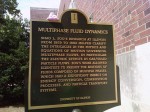
Multiphase Fluid Zzzzzz...
But it turned out not to matter much, as the markers were everywhere. Remember what I said about scientific breakthroughs? Yeah, it was Nerdtopia. Nerdvana, if you will. I fell asleep just reading the title of “Multiphase Fluid Dynamics,” but melydia seemed to know what it was talking about. (Nerd.) Thank goodness we stopped for ice cream after that, so I could take a rest from all this modeling. Being gorgeous can really work up an appetite. Melydia wouldn’t share, though. Something about “not having a mouth.” Whatever. She was just being selfish.
No ice cream for me!
The family was getting pretty tuckered out by that point, so after a couple more snarfs on campus, we stopped by the Cattle Bank (also known as the oldest building in town) and the New Orpheum Theatre (now a children’s museum). One of the
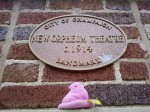
City of Champaign Landmark?
signs on the Orpheum designated it as a “City of Champaign Landmark.” Melydia was curious if there was a list of these local landmarks, but her parents and husband were tired, and since Dad was driving, they went straight home.
I thought we were done with landmarks for the trip, and I would be stuffed in melydia’s purse for the rest of the visit, but I was wrong. Dad had one more marker up his sleeve. A couple days later, we drove out to a cornfield near the tiny village of Bellflower to see a bit of glacier rock (that is, a rock shaped by a glacier) memorializing the generous donation of the Flanigons to the Bellflower schools. After a quick trip through the long-closed Chanute Air Force Base for a quick peek at the old planes, we stopped at Hickory River for some
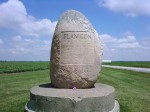
Bonus snarf!
delicious barbecue. (At least I assume it was delicious. Once again, melydia wouldn’t let me have any. Oh well, I guess all great models have to watch their figures.)
So that was my trip to the midwest. I guess there was some other stuff too, like fireworks and s’mores and puzzles and stuff, but I was stuck in the purse for all that. This was just the important bits.
Xenocide by Orson Scott Card
Xenocide by Orson Scott Card: The third book in the Ender Wiggin saga was not originally intended to involve Ender at all, and it kind of shows. Most of the story revolves around a couple “god-spoken” denizens of the Chinese-ish world of Path, who believe the gods tell them what to do in between demands for absurd and humiliating purification rituals. The characters are generally either uninteresting or unlikeable, but Card’s writing is good enough that it isn’t too tiresome. However, the metaphysical, philosophical, and religious discussions get old, and too often Card falls into the trap that ensnares so many male SF/F writers: making women self-righteous harpies in lieu of actually giving them personalities. Ella alone escapes this fate, though that may be due to her lack of romantic interests. While I enjoyed the more in-depth discussion of the descolada virus and Jane’s origins, I could have done without Ender’s unrealistic marital problems and the deus ex machina of “outside.” (Those who have read the book will know what I mean.) I sincerely hope the next (and once last) book in the series, Children of the Mind, will bring some closure to the ridiculously tangled story going on here. Otherwise I’ll probably wish I’d stopped after Speaker for the Dead.
Also posted on BookCrossing.
Speaker for the Dead by Orson Scott Card
Speaker for the Dead by Orson Scott Card: I consider this less the second book in a series or even a mere sequel than the second half of Ender Wiggin’s story. What began with his troubled childhood in the Battle School concludes on the planet of Lusitania, where the first intelligent alien species in 3000 years has been discovered. The Piggies, as they are affectionately called, are full of mysteries and questions, but they seem friendly enough. However, when two xenologists are found brutally slain by the Piggies, fear and suspicion begin to spread through the human colony. It’s another solid story about understanding alien societies, full of memorable and realistic characters. As an added bonus, most of the questions raised in Ender’s Game (how did the video game know about Peter, what happened to the Hive Queen etc.) are answered. Definitely an excellent book. I’m surprised people don’t praise the pair of novels as much as Ender’s Game alone, actually. I’m glad I read this. Highly recommended.
Ender’s Game by Orson Scott Card
Ender’s Game by Orson Scott Card: I first read this between fifteen and twenty years ago and remember really enjoying it then. This time was no different. Ender is a brilliant child soldier, drafted into Battle School at the age of six. He and his comrades are training to fight the Buggers, a hostile alien race who have invaded Earth twice already with terrible casualties. Though it sounds from this two-sentence description to be your standard military science fiction, it is something quite apart from those. This is not about the glories of war, but rather the troubles of a young child forced to grow up before he’s even reached puberty. It’s also the story of his two brilliant siblings, left on Earth to deal with their own troubles. Ender is extremely sympathetic; even when he was cruel I only pitied him. This is definitely one I will be reading again someday.
The Artist’s Way by Julia Cameron
The Artist’s Way by Julia Cameron: I confess, I didn’t do this as a twelve-week course. I tried a couple times, but realized that I was never going to be able to set aside three months for a self-guided class, so I went ahead and read it straight through. I suspect I waited too long, as I am not creatively blocked anymore. The ideas in the book are very good – the morning pages in particular are a useful habit to have. I wish there was a little less God talk, but the cover did warn me that this was a “spiritual journey” so I can’t really complain. The thing is, so many of the things attributed to God don’t have to be – for instance, unblocking your creativity doesn’t necessarily mean that God’s giving you more opportunities, just that you’re more open to spotting and pursuing said chances. But anyway, if you want to be more creative and just can’t seem to get yourself to do it, try this out. It certainly can’t hurt.
Also posted on BookCrossing.
The Bonesetter’s Daughter by Amy Tan
The Bonesetter’s Daughter by Amy Tan: This is the third of Tan’s books I’ve read, and follows a similar pattern to the other two (Joy Luck Club, Kitchen God’s Wife): rebellious American daughter of misunderstood Chinese mother, culture clashes combined with generational differences, mother’s secret childhood in China eventually is revealed to daughter, understanding ensues. Luckily, Tan’s lyrical prose helps the formula remain fresh. The ending was unfortunately not as tight as it could have been; things were too tidy to be realistic, as if Tan were rushed to get the story out the door. I kind of think that if it were only the mother’s story it would have been good as it stands, without mentioning the daughter at all. But it was still a good read – up until the end.
Also posted on BookCrossing.
Seize the Night by Dean Koontz
Seize the Night by Dean Koontz: This is the second Chris Snow book, after Fear Nothing, and the character has finally found his own voice. One of my complaints in the previous novel was Chris’s lack of a personality: he acted differently depending on who he was talking to. This time, however, he’s far more consistent, as are the other characters. Unfortunately, the plot surrounding him is far weaker. Koontz can’t decide what to use as the Big Bad, so he throws in a little bit of everything: sociopathic serial killer, genetic engineering, time travel, evil government/military types, etc. It gets a little silly after a while. Chris’s XP (a genetic disorder which means he can’t handle UV light) is almost forgotten for most of the story, which is a little strange considering how many times there are talks about fluorescent lights blinking on and, more importantly, the infrared goggles. Perhaps Koontz doesn’t know this, but IR goggles require a digital screen, meaning that Chris basically put a small computer monitor against his eyeballs which are supposedly so sensitive he can’t sit too close to a television. But oh well, that’s certainly the least of the inconsistencies in these books. Chris Snow is a great character, as are his buddies (Sasha, Bobby, Roosevelt, Doogie, Orson); I just wish they’d been given a better plot to play in.
Also posted on BookCrossing.
Out of the Fallout by Veronica A. Mullen
Out of the Fallout by Veronica A. Mullen: Self-published novels are, in general, self-indulgent and extremely hard to follow. Luckily, Out of the Fallout is an exception to this rule. It is rife with typographical and grammatical errors, but if you can look past that you’ll find a surprisingly engaging story. The plot is rather complex, set in a post-apocalyptic world where the chemical and biological weapons of the last war caused unexpected psychic abilities in a large portion of the population. Jason and Michelle, however, are two of the extremely rare “natural” psychics. They live at The Psychic Research Center, a cross between a school and a laboratory for juvenile victims of the psychic virus, where children are kept apart from the “normal” population in order to be studied and to learn to control their newfound abilities. Jason and Michelle, though prized by the scientists as test subjects, are ostracized by the rest of the children. Michelle’s unusual behavior – in response to spending her formative years held hostage by a serial killer – makes her even more of a target. The story chronicles their lives over several years, from teenagers to adults, as Jason struggles to find normalcy and Michelle withdraws ever more deeply into herself. The ending completely lost me – the random forays into Greek mythology, the unexplained bird creature, the bizarre dreams, the abrupt conclusion – but otherwise I enjoyed this one. If another edition ever comes out – one where the second half of the book is as detailed and engrossing as the first – I will certainly pick it up. In the meantime, I’ll keep an eye out for Mullen’s future works.
Also posted on BookCrossing.